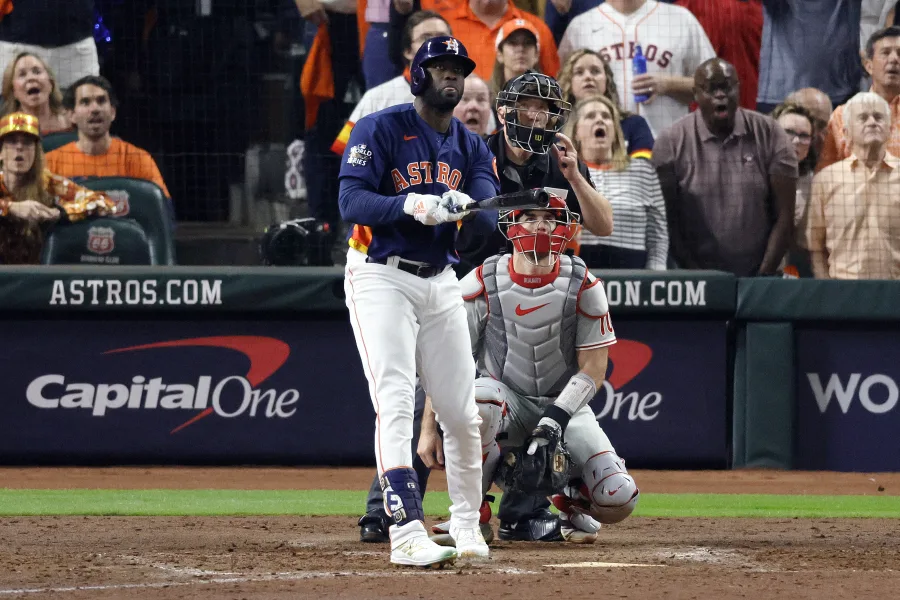
If Yordan Alvarez were to never take another swing in a professional baseball game, his legacy would still linger in the minds of Houston Astros fans for years to come. When Alvarez turned World Series Game Six, and Minute Maid Park, upside down on November 5th, he took a poetic trot around the bases for the final time that season. The monstrous 450-foot shot didn’t quite end the game, but it certainly seemed to put it out of reach. It was the perfect bookend to the Astros’ postseason run – one that began 25 days earlier with a historically improbable walk-off from that same man. For Alvarez, it was a postseason attached to perhaps the best offensive regular season by an Astro since Jeff Bagwell’s MVP. While his collective postseason performance may not have matched that of the regular season, the moments he provided certainly did.
It is always important to go back and appreciate what occurred during the 162 game grind to ultimately get to those special moments. Possibly overshadowed at times by Aaron Judge’s AL home run record chase (and understandably so), Alvarez put together an incredible regular season of his own on his way to a third place finish in AL MVP voting.
Alvarez was already great. Any casual baseball fan could see that. He burst onto the scene with 27 home runs in 87 games as a rookie in 2019. After knee surgeries kept him out of the shortened 2020 season, he followed up that rookie year with a strong 137 wRC+ in the 2021 season. In 2022, he finished with a 185 wRC+, a top-ten single season mark since the retirement of Barry Bonds. How, though, did Alvarez elevate from great to transcendent?
Alvarez had already established himself in the slugger department with his massive home runs and gaudy batted ball data. It was his plate discipline numbers that ultimately put him over the top in 2022. He increased his walk rate from 8.4% to 13.9%. He cut his strikeout rate from 24.2% to 18.9%. Making gains of that level in both departments is quite impressive. It is fair to assume that anyone who improves both their walk and strikeout rates by over 5% has also improved their overall batting line.
I looked into the significance of Alvarez’s improvement within the context of recent baseball. Beginning with 2015 (the start of the statcast era), I examined the largest year-to-year improvements in K-BB% (minimum 350 plate appearances – both seasons). The lower the better here. Omitting 2019 to 2020 or 2020 to 2021, due to the shortened season. This is what the top-ten leaderboard looks like:

Out of 873 such season-to-season samples, Alvarez’ improvement from 2021 to 2022 is the third largest. Combine that with batted ball data that looks like this:

It’s not difficult to envision how Alvarez finished second in baseball in both wOBA and wRC+.
As mentioned earlier, such improvements in your walk/strikeout rates generally indicate x player improved their overall offensive contributions. Improvements of this magnitude also generally point towards a player’s approach and contact abilities improving. These things are not perfectly correlated, but they’re probably the first place to visit when examining a change in plate approach. Below is the leaderboard with the same players above, now showing their underlying plate numbers:
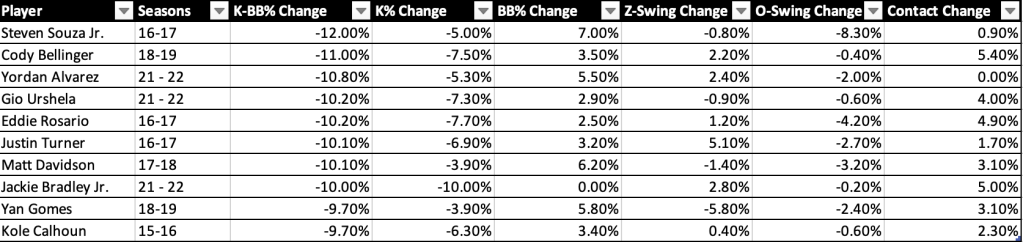
Alvarez improved his discipline at the plate. He swung at more strikes and at fewer balls, a change that almost always leads to improved results. His contact rate did not change at all. When you examine the results around this leaderboard, Alvarez changes at the plate overall are less pronounced than other players on the list. Cody Belling significantly improved his contact ability. Steven Souza stopped swinging at so many balls. Matt Davidson and Yan Gomes did both. What accounted for Alvarez’s improvement?
Your first thought may be intentional walks. And yes, these intentional walks did play a factor. Alvarez was performance proved he was quite worthy of them. Alvarez was intentionally walked three times in 2021 as opposed to nine times in 2022, with fewer plate appearances in 2022. However, his rate still increased a sizable 4.45% when omitting the intentional ones.
With every plate appearance that does not result in an automatic free pass, there is a story. The result may look the same in the box score, but the pitcher and hitter battle. Sometimes it is easily won – other times not. So, I examined the manner in which Alvarez has achieved his walks the past two seasons. Here are his walks by count, in 2021 and 2022:

Even if they don’t waive the white flag immediately, pitchers will sometimes still proceed with extreme caution against certain hitters. This seemed to be the case many times for Alvarez this past season. Rather than finding himself in a full count for most of his walks, he was often able to take the easy pass on 3-0 and 3-1 counts. Below is the zone rate of pitches to Yordan Alvarez, broken down by count:
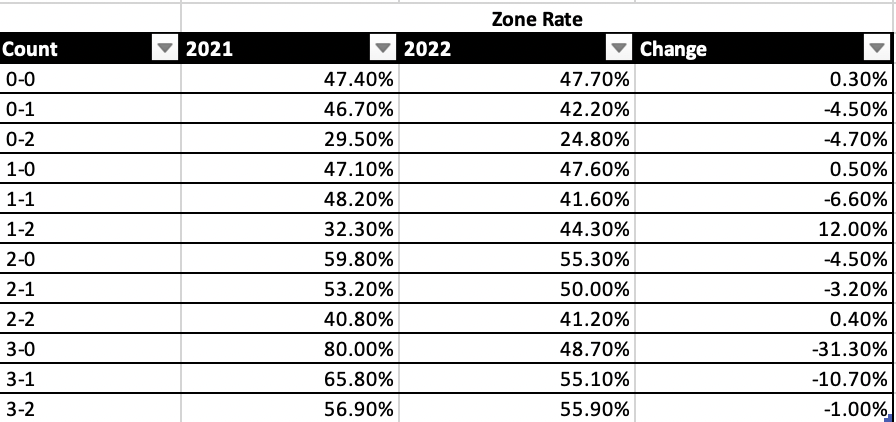
Down 3-1, pitchers were significantly more cautious this season. In 3-0 counts, they were downright terrified of Yordan Alvarez. Less than half of the pitches he saw in 3-0 counts were in the strike zone. For reference, in the midst of one of the most dominant offensive seasons in recent memory, Judge saw 70% strikes on 3-0. Pitchers essentially threw in the towel against Alvarez once they were put in serious hitter’s counts. That made walking a much easier task for Alvarez.
Now, shifting to Alvarez’s strikeouts. As seen above, his contact rate remained stagnant. His overall swing rate remained stagnant. He didn’t go into full protect mode with two strikes. He actually swung 8% less often down 0-2, and his other two strike swing tendencies had no noticeable difference. Perhaps he took advantage of hittable pitches early in the count. So, I took a look at his swing tendencies at pitches thrown inside the strike zone, broken down by count:

The biggest discrepancy comes in 2-1 counts, where he was actually much more willing to watch strikes pass by. He was also less eager up 2-0. Considering how pitchers treated him in three ball counts, that makes sense. He was also much more aggressive on strikes in 1-2 counts. The 1-0 and 1-1 hitting have big changes in opposite directions, which doesn’t mean he was particularly more aggressive when seeing strikes early in the count. The tendencies overall don’t point towards any overarching trend of Alvarez jumping on hittable pitches early.
When researching such massive changes for players, it often feels like it can’t be so simple. In 2021, 54.2% of his at-bats reached a count with two-strikes. In 2022, Alvarez cut that number to 47.8%. The MLB average was 53.5%. You can’t strikeout without two strikes on you. Sometimes, maybe it is that simple: Alvarez didn’t put himself in position to strikeout as often. Perhaps Alvarez cleaned up his swing decisions just a bit, spit on a few more pitches outside the zone, and everything clicked from there.
It is worth noting his two-strike hitting was a sort of catalyst for his season. He didn’t end up there nearly as often, but he made the most of it when he did. In his solid 2021 campaign, he struggled in those situations, relative to his overall achievement. In 2021, he ranked 153rd in the MLB with a .239 wOBA with two strikes. Last year, he ranked 27th in the MLB with a .289 wOBA (both min. 300 PAs). He also struck out 5% less often in those situations.
Yordan Alvarez was incredible in 2022. In his second full MLB season, he added on to his unbelievable batted-ball numbers to become a complete player. How did he do it? He took more efficient walks, as pitcher’s shied away from him in hitter’s counts. He put himself in a position to strikeout far less often. When he did end up in those two-strike positions, he improved to still remain a dangerous hitter. With that improvement, Alvarez brought a World Series, along with plenty of memories, back to Houston.
 SabrStros